 Using a feature service
ArcGIS from ESRI, along with other online georeferencing services, provide vast repositories of vector geometry and associated data in the form of feature service layers. Groups of similar geographic features and data are available to designers, in numerous categories such as buildings, parcels, cities, roads, bus routes, and much more; at import, these become points, lines, and polygons, or groups of these objects with attached data records. These data can be downloaded and then used in Vectorworks in the form of a feature service that is bound to a design layer (Design Suite product required). Design layers that are bound to a feature service are best used as layers of visual data on top of a base map or geolocated image.
Some services require logging in to an account, while others are available free of charge; keep copyrights in mind when using a feature service. If you are logged into a service such as the ArcGIS portal, where you can maintain sets of drawings for use by a team of designers, you can download a feature layer and make edits to it in Vectorworks.
Binding a layer to a feature service
|
Command |
Workspace: Path |
|
Bind Layer to Feature Service |
Design Suite, Architect: AEC > GIS Landmark: Landmark > GIS Spotlight: Spotlight > GIS |
Bring in georeferenced shapes and data from an online service by binding, or associating, a design layer with the service and the selected data.
To bind a design layer to a feature service:
Creating a new design layer for the feature service association is recommended. See Creating layers.
Select the command.
Alternatively, edit the layer and click Bind to Feature Service in the Edit Design Layers dialog box.
If the design layer was not already georeferenced, it becomes automatically georeferenced. Specify the coordinate system and other georeferencing information.
The Select Service dialog box opens.
Click to show/hide the parameters.Click to show/hide the parameters.
|
Parameter |
Description |
|
ArcGIS portal |
Select a standard or custom portal for obtaining ArcGIS data |
|
Select a portal for the ArcGIS data; typically, this will be the arcgis.com web site. Click Login to enter your credentials. Large organizations may have a custom portal; a custom ArcGIS Enterprise portal URL can be specifed by advanced users. A custom portal uses your organization's locally hosted feature services directly through its own servers. To customize these options, select Manage Service or Portal List from the Portal list to open the Manage URLs dialog box. The list of available services and portals, their names, URL, and types of service displays. From there, click Add URL to open the Add ESRI Portal dialog box; here, follow the information to enter a redirect URL and specify the obtained developer credentials, and then click OK to add the enterprise portal to the list of URLs. From the Manage URLs dialog box, you can also click Edit to edit a selected URL, or click Delete to delete a selected URL. |
|
|
Login |
If the selected portal requires a login, click Login. The login process varies, depending upon the portal or service. |
|
Set Public URL (when not logged in) |
Opens the Edit URL dialog box, to use a public ArcGIS Online URL without a login |
|
Browse for a service from |
Select a category of service: Portal, ArcGIS Living Atlas, or ArcGIS Online. The Portal service list allows you to select your content, favorites, or your organization. |
|
Service Parameters |
Once you have selected a category of service, you can browse through the services available in that category. Search for the service by entering text in the search box, or browse through the services by clicking << or >>. Select the service from the Name list; its parameters display on the right. |
|
Web Feature Service (WFS) |
A number of Web Feature Services are available by default |
|
Preset |
Choose a global region, and then select a feature service; its URL displays |
|
Set URL |
Opens the Edit URL dialog box to set a custom location for a web feature service |
|
Manage Presets |
Opens the Manage URLs dialog box. The default preset feature services are listed; add a new service and its URL by clicking Add. You can also click Edit to edit a selected URL, or click Delete to delete a selected URL. |
|
Copy URL |
Copies the selected URL so that it can be shared |
|
Service Parameters |
Once you have selected a preset and a feature service, the services display in the Name list. You can search for the services available by entering text in the search box. Select the service from the list; its parameters display on the right. |
Select either an ArcGIS portal service or a Web Feature Service (WFS) to associate with the active layer.
The Select Features for Layer dialog box opens.
Depending on the type of data and the design needs, do one of the following:
To only obtain features for the current view's extents, limiting the amount of data to download and manage in the file, select Request features overlapping the view region.
To obtain all features available from the service, which could result in slow performance and a large file, select Request all features on the feature layer.
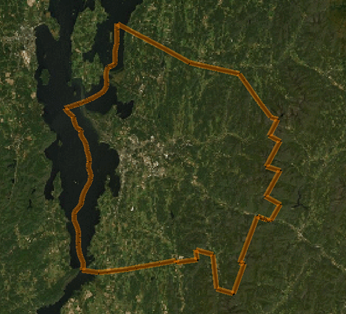
The feature layer is downloaded and displays on the associated layer. The features are added as simple objects or a group of Vectorworks objects (points, lines, and polygons) with record format data attached.
Updating a feature service layer
|
Command |
Workspace: Path |
|
Update Layer from Feature Service |
Design Suite, Architect: AEC > GIS Landmark: Landmark > GIS Spotlight: Spotlight > GIS |
A feature service bound to a layer may require updating to get the latest location information or other data. You may also want to switch the feature service area, to extend or limit the extents of the downloaded features.
To update a feature service layer:
Make the bound layer active.
Select the command.
The Select Features for Layer dialog box opens. If desired, change the extents of the features area to download.
Objects and attached record format data update with the latest feature service information.
